01 / Flagship project · Independently developed
Active developmentAbsolute AI
A general-purpose AI system that I am building on my own. One FastAPI backend connects AI models, memory, research, tools, and devices. The same interface runs in the browser and as a Windows desktop app, and a paired Windows agent can carry out approved actions on my computer.
168
Backend unit tests passing
Public cloud-source-latest branch (commit 1c773dd), last run on 13 Oct 2026.
10
Real-desktop tests not run
They control the real computer, so they were not part of this check.
6
Public branches
The main branch has the early backend. Current work is on the development branch.
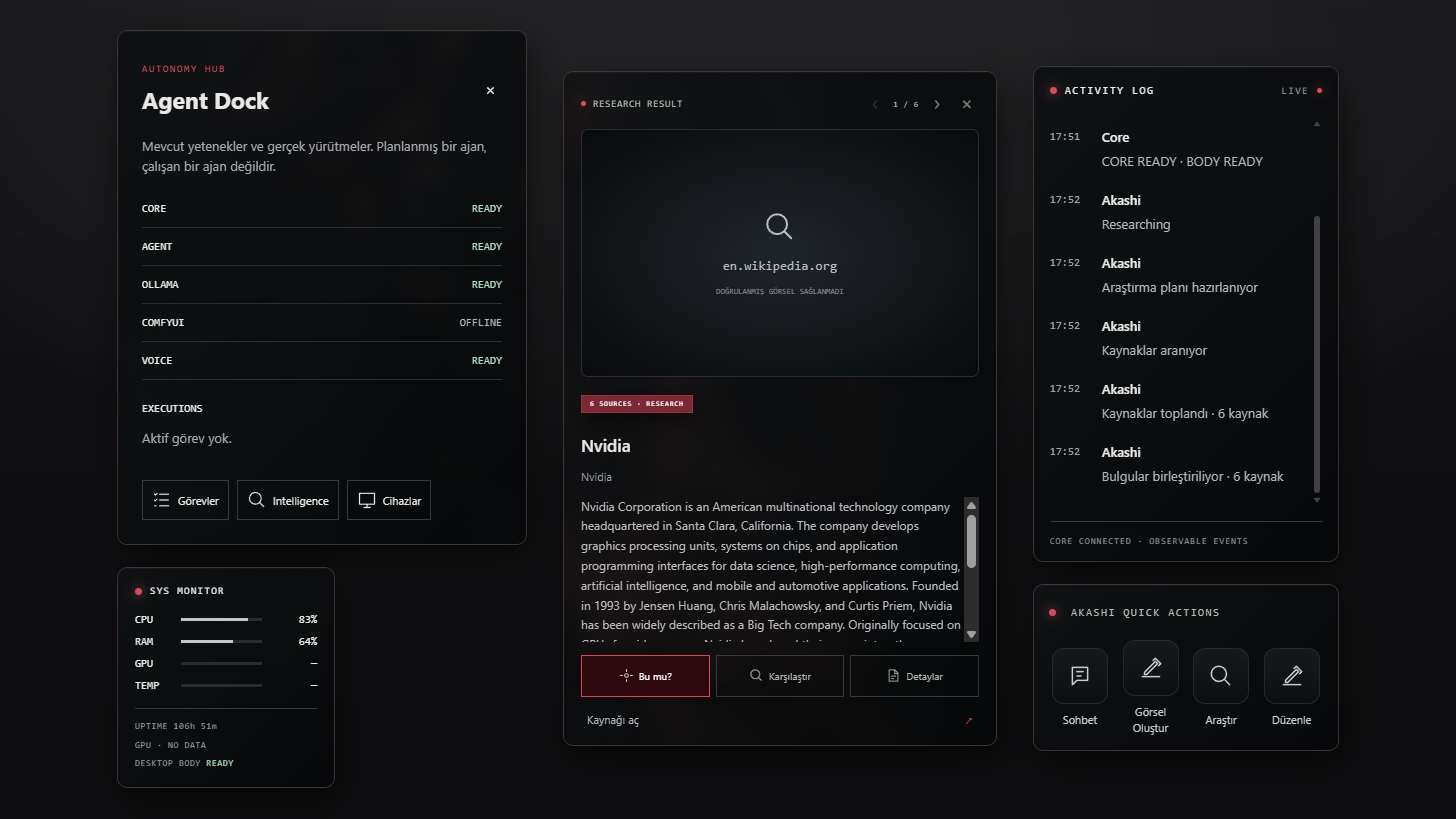 Real screenshots
System architecture
Diagram drawn from the repository documentation — not a screenshotClients
Web
Next.js, static export
Windows app
Hardened Electron shell
Android / iOS
Capacitor — experimental
AKASHI Core — FastAPI
Brain
Intent, persona, context
Memory V2
Summaries, long-term
Model router
Fast · quality · reasoning · vision
Research
Queries, sources, citations
Tools & tasks
Risk levels, approvals
Autonomy engine
Goal graphs — experimental
Devices
Pairing, action queue
Files
Validated uploads
Event stream
Authenticated SSE
Models, services, devices
Gemini · Ollama
Cloud and local models
Wikipedia · SearXNG
Search providers
ComfyUI
Local image generation
Windows Agent
Paired, polls for actions
Device actions
Built- App
- Core action queue
- Windows Agent polls
- Runs one named action
- Result + event
Always-on desktop voice
Experimental- Desktop mic
- Gemini Live audio
- Tool requests → Core /chat
Phone calls
Experimental- Phone call
- SIP trunk
- LiveKit SIP
- Phone worker
- Core /chat
Engineering work
What is built, what is experimental, and what is planned
FastAPI Core & model routing
One backend owns every AI request. A router picks a model profile (fast, quality, reasoning or vision) and sends it to Gemini or a local Ollama model.
test_core_api.py · test_intent.py
Memory V2
Long sessions are compressed into summaries without changing the stored format. Long-term memory is saved only on request and rejects values that look like secrets.
test_memory_v2.py
Research with source tracking
Deep mode runs several search queries and removes duplicate sources. Each extract stays linked to its source, and citations come only from retrieved pages.
test_research.py · screenshot above
Tool permissions & approvals
Every tool has a risk level: safe, confirm or restricted. A task that needs confirmation waits for my approval, then runs its steps and saves the result.
test_tools_tasks.py
Device pairing & security
One-time pairing codes, salted token hashes, token checks on private routes, and private memory that public chat cannot read.
test_devices.py · test_auth.py · test_absolute_security.py
Web & Windows apps
One Next.js interface runs in the browser and inside a hardened Electron shell. The packaged Windows app passed its own visual test.
Packaged-app visual test, 21 Sep 2026
Windows desktop agent
Observe, act, verify. State-changing actions need approval and free terminal typing is blocked. The real-desktop tests were not part of my latest check.
test_computer_agent.py (unit tests only)
Autonomous planning & recovery
Goals become dependency graphs. Failed steps are observed again and retried, and a restart keeps checkpoints without assuming that unfinished work succeeded.
test_autonomy_v2.py · no long real-world runs yet
Voice & Live integrations
Always-on desktop voice through Gemini Live, and inbound phone calls through SIP and LiveKit. Both depend on external services.
test_voice_sessions.py · test_phone.py
Android & iOS apps
Capacitor shells reuse the same interface with native speech input and output. I have not verified them on real devices yet.
Source only
Next goals
Not built yet.
- Long autonomous tasks, tested end to end in real use
- Live camera effects that adapt in real time
- Control of embedded devices
Engineering challenges
Problems I had to solve
Apps should not each hold API keys and their own AI logic.
SolutionAll AI requests go through FastAPI Core. Desktop voice is the only exception: it streams audio straight to Gemini Live for low latency, but it still sends tool, memory and research requests back to Core.
An AI that can act on a computer can also cause damage.
SolutionRisk levels for every tool, approval before state-changing actions, blocked free terminal typing, one-time device pairing, and tokens stored only as salted hashes.
Desktop and browser steps fail often.
SolutionAn observe–act–verify loop. A failed action is observed again and retried, and a rejected result leads to a new plan with recovery steps.
A restart can hide what really happened.
SolutionTasks and voice sessions keep checkpoints. After a restart, unfinished work is marked as interrupted, never reported as successful.
My reflection
Draft — pending reviewI started Absolute AI because I wanted an assistant that could do more than answer messages. A chatbot can explain how to fix something, but I wanted a system that could take an action, check the result and continue. That goal shaped my main decisions. I put all of the AI logic in one FastAPI backend, so every app uses the same memory, tools and safety rules.
Computer control is the hardest part. Apps and websites change, steps fail, and a model can sound confident and still be wrong. Because of this, I added risk levels, approval steps, retries and recovery plans, and I made the system mark unfinished work as interrupted instead of successful. Building memory taught me that saving everything is not useful; the system needs clear rules about what to keep and what to compress. Next, I want to test the computer agent on longer real tasks, record honest demos, and move the stable parts into the main branch.
Demonstration
Demo in preparation
4 planned recordings
- 01AI research and tool execution
- 02Windows Agent completing a real task
- 03Failure recovery and task continuation
- 04Voice interaction — only if a working demo is recorded